The Passion Translation
- Lacks Translation Standards: Does not meet any scholarly criteria for legitimate Bible translation; peer-reviews, trusted sources, biblical language credentials.
- Lone Author with Dubious Claims: Brian Simmons, the sole translator, lacks formal training in biblical languages and claims direct, supernatural "downloads" of secrets from Jesus, including promises of "new" chapters in the Bible.
- Inaccurate Source Use: Sourced on inaccurate 5th-century Aramaic texts as Simmons claims the New Testament was written in Aramaic.
- Added and Altered Text: Adds more than 50% extra material, and alters existing material.
The Passion Translation claims to be a translation yet does not meet a single criteria for being a translation.
1. Fails Scholarly Translation Standards
Reputable Bible translations (e.g., ESV, NASB, NIV) adhere to rigorous scholarly standards:
- Teams of qualified scholars in Hebrew, Greek, and Aramaic ensure fidelity to the original manuscripts.
- Translators follow established principles like textual criticism and transparency about sources.
- The translation process undergoes peer review, where others with expertise evaluate its accuracy.
For example,
The ESV was translated over the course of 10 years, based on the 1901 ASV and the 1956 RSV translations. It was translated by over 100 Biblical, Greek, Hebrew, Aramaic, Theological scholars.
The Passion Translation, however:
- Was produced by one man, Brian Simmons, who lacks formal education in biblical languages and translation methodology.
- Does not adhere to peer-reviewed scholarly checks and balances, making it inherently unreliable.
2. Unverified and Dubious Claims
Brian Simmons claims that:
- Jesus personally commissioned him to produce TPT.
- He received "downloads" of divine secrets, including new chapters of Scripture (e.g., John 22) unavailable to others.
These claims lack and biblical precedent and accountability:
- Scripture warns against adding to God's Word (Revelation 22:18-19).
- Historically, God inspired the biblical authors within their linguistic and cultural contexts (e.g., Moses, Paul)-never through unverified private revelations to one individual post-canon.
- Supernatural experience does not equal validation. The Bible already provides sufficient revelation (2 Timothy 3:16-17).
3. Textual Inaccuracies
Simmons claims the New Testament was written in Aramaic, prioritising 5th-century Peshitta manuscripts over the universally recognised Greek manuscripts (all dated in the 1st-century). This contradicts:
- Historical Evidence: Greek, not Aramaic, is the language of the earliest manuscripts and the lingua franca of the Roman world.
- While Jesus spoke Aramaic, all New Testament writers wrote in Greek. Further, Jesus was bilingual and regularly quoted the Greek Septuagint.
- Scholarly Consensus: The Greek New Testament (e.g., Nestle-Aland or Textus Receptus) forms the textual basis for all major translations.
Reliance on later, less accurate sources introduces errors and undermines the authenticity of TPT.
4. Significant Alterations
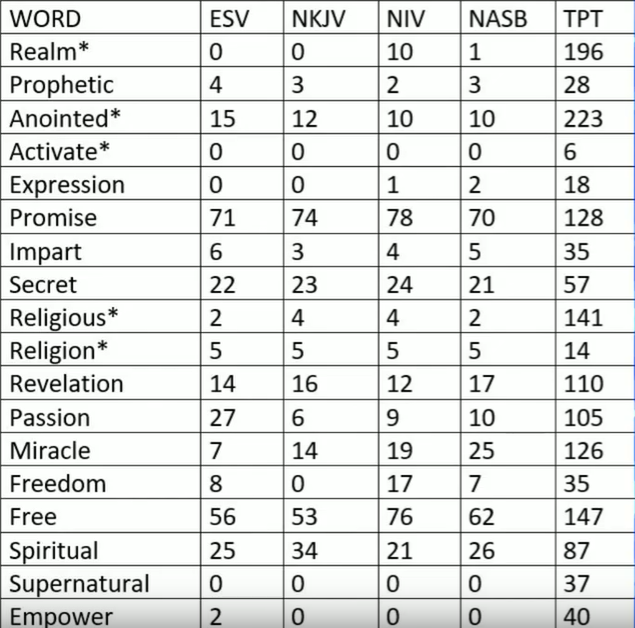
The Passion Translation frequently expands the biblical text, inserting interpretations and additional material not found in the original. Scholars estimate that TPT is 50% longer than standard translations.
The Passion Translation abandons all interest in textual accuracy, playing fast and loose with the original languages, and inserting so much new material into the text that it is at least 50% longer than the original. The result is a strongly sectarian translation that no longer counts as Scripture; by masquerading as a Bible it threatens to bind entire churches in thrall to a false god.
For example, here is Galatians 2:19:
- ESV: "For through the law I died to the law, so that I might live to God."
- TPT: "For through the law I died to the law so that I might live for God. My old identity has been co-crucified with Messiah and no longer lives, for the nails of his cross crucified me with him. And now the essence of this new life is no longer mine, for the Anointed One lives his life through mewe live in union as one!"
TPT's paraphrased additions blur the line between translation and commentary, introducing doctrinal bias and potentially misleading readers. While paraphrases (like The Message) can aid understanding, they must not be passed off as Scripture. Labeling TPT a "translation" is inaccurate and deceptive.
Here is another example of the additions to The Passion Translation in comparison to other trusted translations.
Theological Concerns
- God’s Word is Sufficient: The Bible, as originally given, is perfect and does not require embellishment or reinterpretation for modern language (Psalm 19:7; 2 Timothy 3:16).
- Inerrancy and Fidelity: Translators must preserve the original meaning to ensure that Scripture remains a trustworthy guide for faith and practice.
If The Passion Translation were marketed as a commentary or devotional paraphrase, it could serve as a tool for reflection (with caveats). However, promoting it as a translation distorts its role and undermines the authority of Scripture.
While TPT may appeal emotionally, it fails to meet the standards required of God’s Word. As believers, we must uphold a high view of Scripture, avoiding translations that compromise its integrity.
How to Choose a Good Translation:
Sources
- Mike Winger - The Passion Translation
- Important Facts About the Passion Translation
- Dr Andrew Shead on the Passion Translation
- Shead, Andrew G. (2016). _"Burning Scripture with Passion: A Review of The Psalms (The Passion Translation)."_Themelios, Vol. 41, Issue 3, pp. 448-457.
- MacDonald, Lindsay G. (2020). "Why the Passion Translation is Problematic." The Gospel Coalition.
- Throckmorton, Warren (2019). "The Passion Translation: Process, Problems, and Passages." Blog Article.
- Metzger, Bruce M., & Ehrman, Bart D. (2005). The Text of the New Testament: Its Transmission, Corruption, and Restoration (4th ed.). Oxford: Oxford University Press.