1 Thessalonians - Living Letters
✨ Summary
(AI Generated from sermon notes)
Background & Context
- Thessalonika: capital of Macedonia, major trade city on Via Egnatia.
- Religious pluralism: many cults (Greek, Egyptian, Roman); pressure to conform.
- Free city under Rome: no taxes, local authority; fiercely loyal to Caesar.
- Christians were accused of political disloyalty for declaring "Jesus is Lord."
- Paul planted the church (Acts 17), was persecuted and fled. Timothy stayed behind to disciple.
1. Work of Faith
- The Thessalonian church turned from idols to serve the living God (1:9).
- Their faith became visible and exemplary to surrounding regions (1:8).
- Faith included exclusivity-they rejected cultural syncretism (2:14-15).
- They received the word not as human, but as God’s word at work in believers (2:13).
- Idolatry reframed: not just statues, but anything that takes God’s role-e.g., control, money, relationships.
- The Thessalonians endured loss of status and security for allegiance to Christ.
- Faith was rooted in God’s unshakable word-not fleeting cultural values.
- Their example was both in living differently and proclaiming truth (1:7-9).
- Paul’s commendation: "You are our joy and crown" (2:19-20).
2. Labour of Love
- They demonstrated brotherly love without needing instruction (4:9-10).
- Love was taught by God, visible in action, and extended to all of Macedonia.
- Christian maturity is not isolated but communal-loving one another is part of sanctification.
- Paul calls it a labour-love requires sacrifice, service, and sustained effort.
- Sanctification includes sexual purity and self-control (4:3-5) as expressions of love that protects others (4:6).
- The Christian’s personal holiness benefits the community; all sanctification is relational.
3. Steadfastness of Hope
- Some believers were disheartened by persecution and death of members; feared they missed Christ’s return.
- Paul reassures: Christ will return visibly and gloriously (4:16).
- The dead in Christ will rise first.
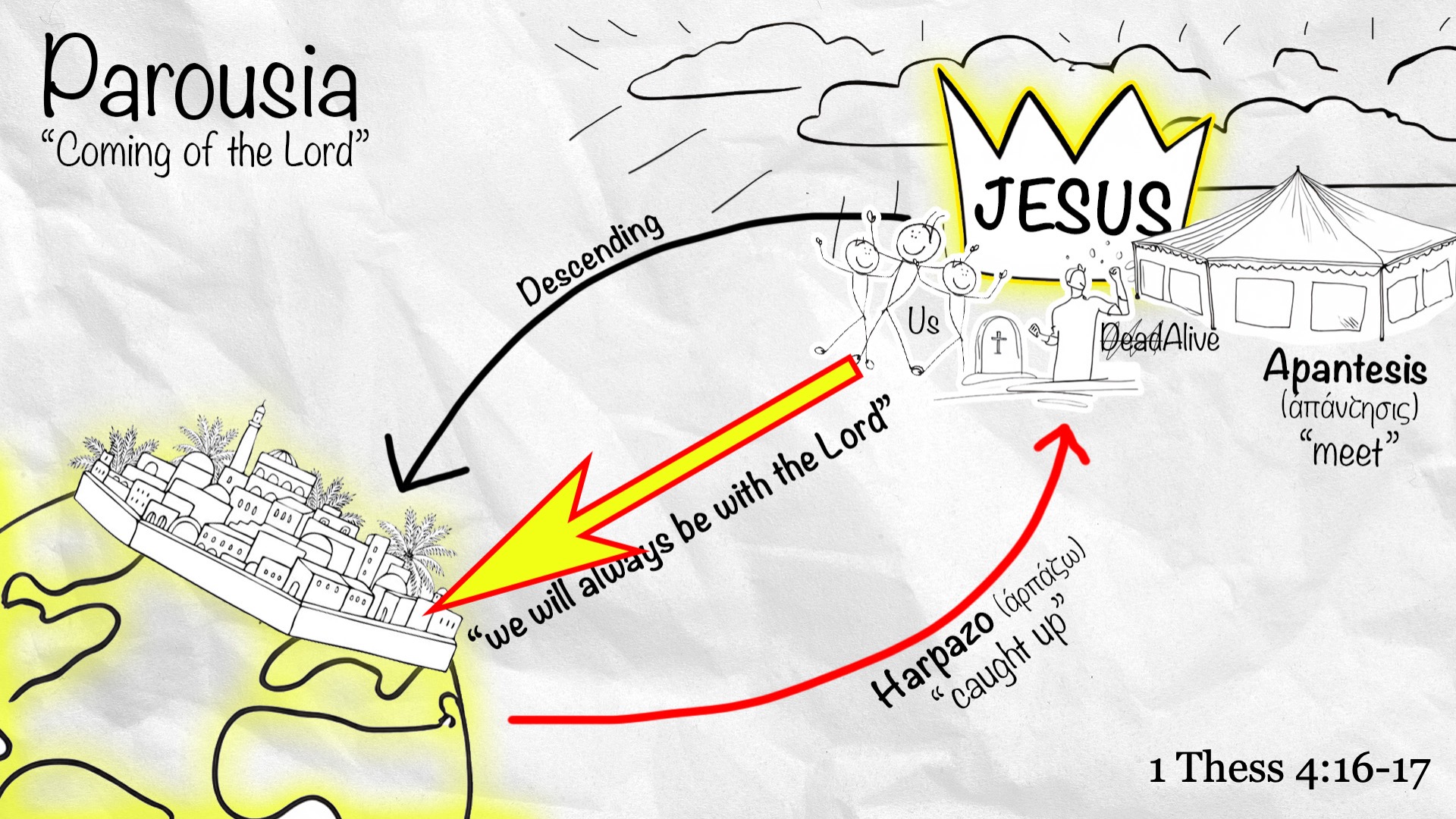
- Then the living will be caught up (harpazo) with them.
- Meeting in the air (apantesis) mirrors royal receptions: meeting the King to welcome Him publicly.
- Parousia: not about escapism, but the royal arrival of Jesus in glory.
- The return is not secret; believers will not miss it (5:1-4).
- Clouds = biblical imagery of God’s glory and presence (e.g., Sinai, Tabernacle).
- Harpazo reframed: not death seizing the believer, but Christ triumphantly gathering His people.
- Apantesis = greeting a royal figure and escorting them in.
- Message: Christ’s return is not about fleeing creation but redeeming and reigning in it.
Summary of the return of Christ (Parousia)
- The Lord Himself will descend - not in secret, but with a cry of command, the voice of an archangel, and the trumpet of God. He's arriving as a king, it'll be undeniable, glorious, and public.
- The dead in Christ will rise first - They're not forgotten. Death does not have the final word over them. They will be raised in victory. Death will be defeated.
- Then we who are alive will be caught up - harpazo, seized not by death but by Christ into life. We are gathered up with the risen saints.
- We meet Him in the clouds - apantesis, like citizens rushing out to honour their King, only to return with Him in triumph. This is a public reception of Christ’s return. And He doesn't then turn around and fly away, He's descending. We welcome Him to reclaim and redeem His Creation.
- And so we will always be with the Lord - never separated again. Not hiding from the world, but reigning with Christ in a restored creation. He's renewing the Earth, a new heavens, a new Earth.
Final Exhortation (5:11-22)
- Encourage and build one another up (5:11).
- Rejoice always, pray without ceasing, give thanks in all circumstances (5:16-18).
- In the meantime: keep working, loving, and hoping.
Key Takeaway
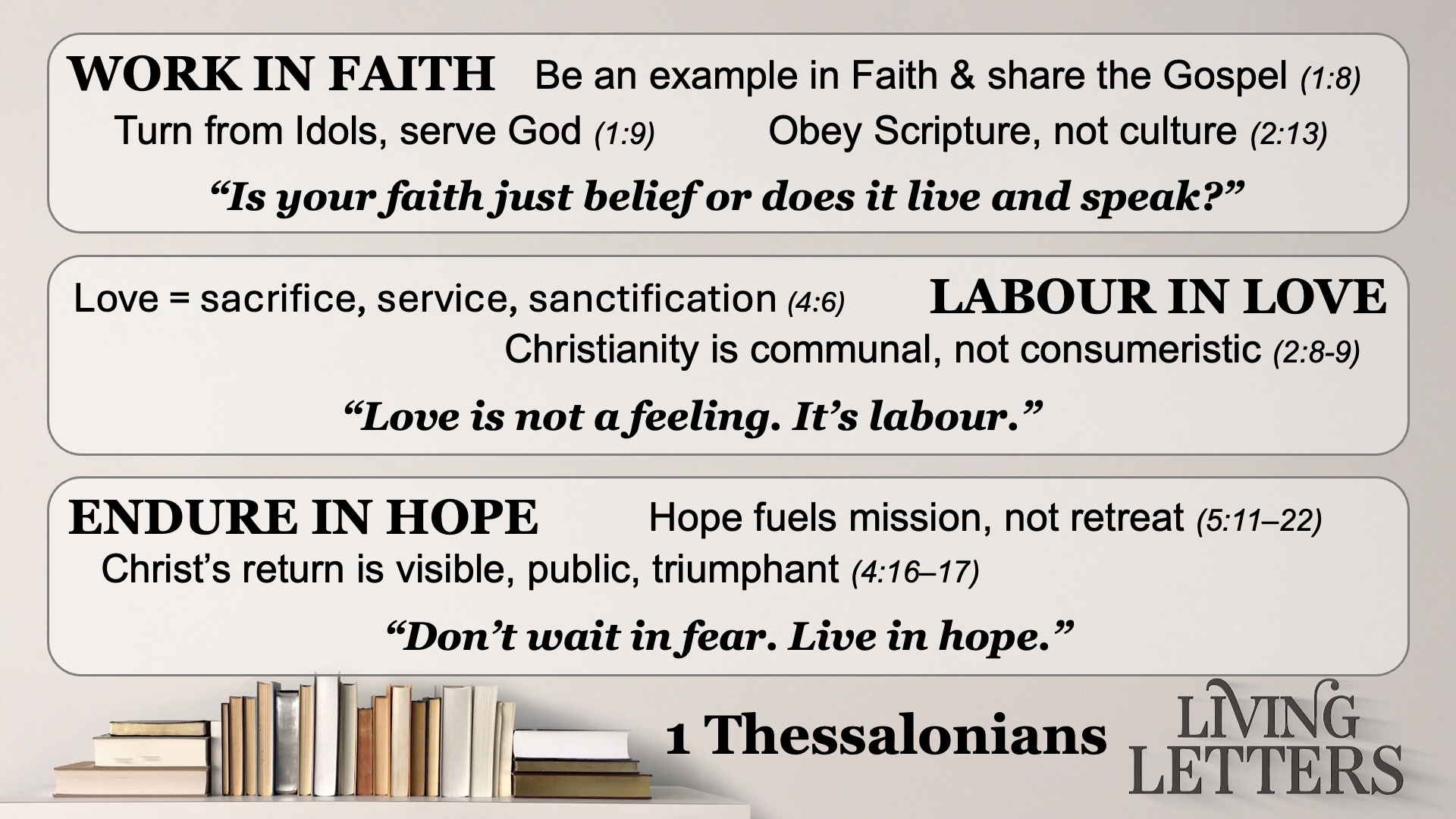
The Thessalonian church is a model of:
- Faith that turns from idols, proclaims truth, and lives distinctively.
- Love that sacrifices, serves, and sanctifies the community.
- Hope that endures persecution, awaits Christ’s return, and fuels mission.
📝 Final Sermon Script
Thessalonika was the Capital of Macedonia on the Via Egnatius (the highway that connected everything to Rome)
- Because of it's location on the road and against the sea, it became a commercial centre with a massive economy, loads of tourists, multiple cults and religous groups.
- On top of all that, Thessalonika was a free town… Rome was it's patron but they were allowed to run it any way they liked because of their loyalty to Rome… No taxes, its own guard.
- So the people LOVED Rome, Rome brought peace or as they called it the "Pax Romana", they allowed them freedom.
Everything was great… Unless you were Christian… If you were Christian in Thessalonika you were likely part of the most persecuted church in the New Testament
- Basically what happened is that Paul gets chased from Philippi & gets to Thessalonika. He preaches at synagogue (Acts 17) > gets the snot beaten out of him and he gets chased off again
- But what he used to do is he would leave Timothy to ninja disciple the Thessalonian Jews.
- The Jewish community then finds out and snitches to the Roman authorities.
- See Rome had this rule "you can worship anybody… as long as you worship the Emperor"
- On top of that Caesar Augustus & Tiberius outlawed the "prediction of future events"
- So Rome is like "ok, you can be a Christian, as long as you get rid of this and get rid of that, oh and also make sure Caesar is lord"
- And for Christians they’re like "we’re not getting rid of anything we believe and, by the way, Jesus is Lord, His peace is better than you Pax Romana, and He’s coming back"
- And all the Thessalonians, they don’t want to lose their free city standing, and so they wanted to stamp out this Jesus cult.
- So, because of Paul, and the fact that Romans & Greeks did not like Christians, there was some intense persecution at the Thessalonian church.
- In 2:14 Paul even says "yeah for reals, you got it bad, they’re like… murdering you"
- "yes, yes we are being murdered thank you very much Paul"
And yet, in spite of all the problems, the church at Thessalonika was strong and thriving.
- One of the craziest truth's about the church throughout history is that the church shines brightest when the world is darkest.
- Or, as one of the early church fathers Tertullian said: "The blood of the saints is the seed of the church"
- Isn't that one of the most heavy metal quotes you've ever heard?
- Who said church was for skinny-jeaned, moisturised, pampered people?
Anyway, Paul's letter is mostly encouraging because the church is going so well.
- Which is nice, because some of Paul's letter are SAVAGE… Actually I saw a video about this that I wanted to show you
Let's open up to this lovely letter
- Paul, Silvanus (Silas), and Timothy, To the church of the Thessalonians in God the Father and the Lord Jesus Christ: Grace to you and peace.
- We give thanks to God always for all of you, constantly mentioning you in our prayers,
- remembering before our God and Father your work of faith and labor of love and steadfastness of hope in our Lord Jesus Christ.
- Here we find the foundational theme of the entire letter:
- Work of Faith
- Labor of Love
- Steadfastness of Hope
- I want to explore each of those but before I want to bring your attention to something that Paul calls a key of faith… thanksgiving.
- What are you grateful for in life?
- What counts as a reason for thanksgiving in your life? Financial growth? How successful your business is?
- The measuring stick we have for our lives is too often influenced by our consumer-driven, profit-oriented culture.
- Yet here’s Paul thanking God for none of these things… Rather, he suggests three other sources of gratitude:
- Work of Faith
- Labor of Love
- Steadfastness of Hope
In other words, when you look honestly at yourself, do you have a Faith that works, a love that labours, and a hope that endures
Faith that Works
For the first three chapters Paul brags about the Thessalonian church.
- He says that they have become an example to all believers.
- He says they became "very dear" to them like their own children.
- And he says how he longs to see them again… It's very lovey dovey.
- They're live the Apostle's pet… The perfect example of how we are meant to live
7. so that you became an example to all the believers in Macedonia and in Achaia.
8. For not only has the word of the Lord sounded forth from you in Macedonia and Achaia, but your faith in God has gone forth everywhere, so that we need not say anything.
9. For they themselves report concerning us the kind of reception we had among you, and how you turned to God from idols to serve the living and true God,
- The faith that works is a faith this is obvious and a faith that is exclusive.
- this is part of the reason they were treated so terribly and why the other people of Thessalonika would have been severely hostile towards the church.
- Because they with all the different clubs and cults around, it was accepted and almost necessary for people to hold various different memberships for social standing and business. It was expected of all.
- Yet, no truly committed Christian could maintain cult memberships. Christians went from various memberships to exclusive ties with the church, and they lost all their prestige and former networks.
But they turned away from idols to serving God.
- When we read this, IDOLS, we think of other Gods, totems, altars, standing in weird circles of robed figures humming.. hmmm
- But can I say that I think we get Idolatry wrong.
- Idolatry is usually defined like "intentionally worshipping something other than God" or "putting something above God in your life" which is true.
- But Idolatry is any time you put something in place of God.
- It's not just idolatry if you say "I bow down and worship you"
- If you're assigning a Role to something, that is meant to be a Role of God in your life. That's idolatry.
- Young people if you expect a relationship to make you whole, you’re asking it to be your Saviour, that's God's role.
- If you expect your job to give your life meaning, it's taking the role of God.
- If you expect money to keep you safe, you’re asking it to be your refuge.
- It's unfortunate that so many people rest their fortunes and their lives on things that cannot hold; beauty that fades, riches that depreciate, fads, fashions, and supposed truths that last a season.
But, what was it that helped the Thessalonian church to remain stable?
- When they're losing their jobs, their social standing, even their ability to purchase things at markets.
- It was their full reception of God's unstoppable, unshakable word to them.
13. And we also thank God constantly for this, that when you received the word of God, which you heard from us, you accepted it not as the word of men but as what it really is, the word of God, which is at work in you believers.
Time for our check up: Is your faith a faith that works?
- As in, are there things in your life that need to be turned from by faith?
- Are you giving something in your life a role that only God is meant to fill?
- Next question: is your life an example of the word of God?
- A faith that works is a faith that is visible.
- And more than that, the word went out from the Thessalonians… so: am I sharing the word of God?
- Not just living it, not just being an example, but am I actually sharing it?
- This is the faith that the Thessalonians had, and that Paul commended
We don't have to strive for this. You don't have to be overwhelmed. We don't work in faith to somehow impress God
- But notice… It is the word of God that is at work in me.
- As I read the word, as I receive the word as if it were God speaking directly to me, as I obey that word, the work of God is produced in me.
- And the work of God in your life is the work of Faith.
Love that Labours
Paul commends them for a Faith that works. He also states that this church is one that labours in love.
9. Now concerning brotherly love you have no need for anyone to write to you, for you yourselves have been taught by God to love one another,
10. for that indeed is what you are doing to all the brothers throughout Macedonia. But we urge you, brothers, to do this more and more,
- Too much of modern preaching seems to be individualised, as if christianity's goal is psychological fitness and healing.
- We looove hearing messages about me, and how I can live a better life, and how I can be benefited.
- And here's Paul addressing individuals "for you yourselves" but in relation to one another "love one another"
- The Christian life is not meant to be lived in personal isolation.
When you and I arrive at church, at connect groups, at work. Wherever another Christian is, Paul is urging us to express love to one another as if they were our own brother.
- Let me tell you this… he also calls this type of love, a labour.
- Let me ask you, are you labouring in loving others?
- Labour looks like refraining from gossip even though I know all the juicy goss from that other church.
- Labouring in love looks like our connect group leaders opening their homes every week, our Foodcare workings providing for the needy, the Rock Kids team discipling all the kids.
- Labouring in love take sacrifice, and sometimes it's hard.
3. For this is the will of God, your sanctification: that you abstain from sexual immorality;
4. that each one of you know how to control his own body in holiness and honor,
5. not in the passion of lust like the Gentiles who do not know God;
6. that no one transgress and wrong his brother in this matter, because the Lord is an avenger in all these things, as we told you beforehand and solemnly warned you.
- Your sanctification. As in you being made holy. As in, you being formed into who God want you to be. You becoming more and more like Christ.
- You think Christianity is just about you being right with God, you learning to be more like Christ, you growing in your faith?
- Paul links that individual work in your life to what? "so that you don't wrong your brother"
- Christianity is so communal, so not individual, that even your individual walk is pictured as being for the benefit of others.
- The picture of the "walk of faith" in the Bible is a journey with a walking group. You are not alone, our responsibility is more than just for me, but to labour in love for one another.
- Our calling is not to isolate but to conduct ourselves as children of God, working in faith and labouring in love
Hope that Endures
And there's a reason why Paul is encouraging the Thessalonians in these things.
- It's because they themselves were starting to retreat. Even though they were an example to all, they were struggling.
- He even had to tell them in 4:11 to go out an get a job. Guy, get out of the basement and "work with your hands"
- See the Thessalonians were under such persecution that when some of them started to die, they began to give up and just wait for Jesus to return.
- They were under such persecution, their world was so dark, they had decided "this is the end times, Jesus must be returning soon"
- So Paul had to encourage them to remain steadfast in hope
13. But we do not want you to be uninformed, brothers, about those who are asleep, that you may not grieve as others do who have no hope.
- See, there was a fear among the Thessalonians that those among them who had died were going to miss out on the glorious return of Christ.
- They were afraid that there dead friends would be looked over, they'd be set aside, left in the dust.
14. For since we believe that Jesus died and rose again, even so, through Jesus, God will bring with him those who have fallen asleep.
15. For this we declare to you by a word from the Lord, that we who are alive, who are left until the coming of the Lord, will not precede those who have fallen asleep.
- "God will bring with him those who have fallen asleep" - your friends who have passed, you don't need to worry because God will bring them with Him
- And so Paul gives them a reason to hope so that the Thessalonians would stop catastrophising, stop being stuck in fear.
- Can I say, this is so relevant for today… If you have fear around the end times, if you have fear about the return of Christ, 1 Thessalonians is for you.
- And the point is this, Paul's writing was to produce hope for the Thessalonians, and that writing is still meant to produce hope for you and me.
- If it produces anything other than hope, you're reading it wrong.
- So, Paul then decides to double down on this message of hope by giving a detailed account of how Christ is going to return.
Parousia
The term that he uses for this event is "the coming of the Lord". You'll find this term through this whole letter.
- The original Greek translation is the word Parousia.
- Now, we fully believe that you can read the Bible, any translation and understand the word of God.
- The Holy Spirit can speak to you and teach you as you read.
- But we also believe that understanding Scripture in it's original context deepens that meaning.
- God chose to speak through Paul to the Thessalonian church in Koine Greek.
- And so if we want to deepen our understanding of God's word, we can study how it would have been understood when God originally authored it.
- And one of the biggest barriers to that is our language… Because the Greek language is different to ours.
- We have one word for love, they have 8. We say "life", they ask "which kind of life… we have three"
And so, as we read the following passage, we can understand the return of Christ simply by reading it
- But in understanding how the Thessalonians would have understood it, we get an even clear picture, and therefore a greater sense of hope.
- And so, as all good end times teaching, I'm I've made us a chart.
A chart of the Parousia
- Parousia is the most commonly used word throughout the whole of the New Testament to refer to the second coming of Christ.
- Strictly speaking, "Parousia" is best translated as Presencing
- As in, the presence of a person… So, Jesus with His disciples was his parousia, The Holy Spirit with us now is his Parousia, and Jesus returning again is his Parousia
- Parousia is not focused on an event, but on a person.
- A common example of Parousia from early Greek culture is describing the arrival of a king or a royal dignitary to a city.
- The people of the city would be overjoyed at the honour of having the king arrived and they would welcome him exuberantly.
- The Theological Dictionary of the New Testament says this: "In Greek culture, Parousia denotes the presence of the gods or rulers, used technically for the visit of a ruler. The customary honours of the parousia of a ruler are: flattering addresses, delicacies, improvement of streets, golden wreaths, and feeding of the sacred crocodiles."
- So, which of us are gonna feed the crocs when Jesus arrives?
- This is how Greek-speaking Christian would have understood Paul, Peter, James, & Matthew when they said this.
- The arrival of King Jesus.
16. For the Lord himself will descend from heaven with a cry of command, with the voice of an archangel, and with the sound of the trumpet of God. And the dead in Christ will rise first.
- Notice how obvious the Parousia of Jesus will be.
- I remember as a single man praying "Lord, please let me get married before you return"
- Some of you were the same…
- And then there's the opposite, where some people are simply terrified that they'll miss it.
- That's what the Thessalonians were saying and Paul's like… Guy's you won't miss it!
17. Now concerning the times and the seasons, brothers, you have no need to have anything written to you.
- Firstly, Paul says, "don't bother trying to work out the day, or the time"
- Don't concern yourselves with what you think are the signs or when you think it's all going to happen
18. For you yourselves are fully aware that the day of the Lord will come like a thief in the night.
- See Josh, like a Thief… Thieves are SNEAKY… Sneaky lil Hobbitses
- We won't notice it, we'll miss it… it'll all happen and I'll miss it
19. While people are saying, "There is peace and security," then sudden destruction will come upon them as labor pains come upon a pregnant woman, and they will not escape.
- I got a question for the women here… Can you miss labour pain? "Oh, I didn't even notice"
20. But you are not in darkness, brothers, for that day to surprise you like a thief.
- So, no… you won't miss it, we won't even be that surprised… We will be fully aware.
21. For the Lord himself will descend from heaven with a cry of command, with the voice of an archangel, and with the sound of the trumpet of God. And the dead in Christ will rise first.
22. Then we who are alive, who are left, will be caught up together with them in the clouds to meet the Lord in the air, and so we will always be with the Lord.
- We have Jesus descending from heaven… It'll be obvious, not a secret, an arrival of a King
- The dead Christians will rise… and then we'll all be with Jesus, together.
- Hey Thessalonians, your dead friends… you don't have to worry about them, there is hope for them.
- Christ is descending and in an instant they will be with Him in the clouds.
What's interesting is that clouds all throughout Scripture is an image of the glory of God.
- Jesus ascends in the clouds in Acts 1, he returns in the clouds in Matt 24 and Dan 7
- The visible sign of God's glory dwelling with his people was:
- A pillar of cloud leading Israel
- Cloud covering Mount Sinai where he met Moses
- The cloud filling the Tabernacle in Solomon's temple
- The clouds are not mainly about altitude or physical location. They represent the presence of God that will accompany Christ’s return in power and majesty.
Harpazo
We will be caught up together with Christ and the resurrected saints in the clouds.
- This word "caught up" is Harpazo (ἁρπάζω)
- Harpazo gives the image of being "snatched away" or "seized"
- A common thing that Greeks would engrave on tomb stones was "He was snatched away (Harpazo) by the Fates".
- So, "death has snatched them up" was a common metaphor used by every Greek.
- And so Paul grabs this and twists it, he flips it on it's head
- instead of death snatching believers away to the grave, Christ snatches them up into resurrection life at His return.
- So harpazo here is not about a forceful removal in death, but about the triumphant reversal of death.
- That at Christ's glorious, kingly return in the glory of God death will be defeated forever.
Apantesis (ἀπάντησις)
One final word Paul uses to paint the picture of Christ's return is the word "meet"
17. Then we who are alive, who are left, will be caught up together with them in the clouds to meet the Lord in the air, and so we will always be with the Lord.
- What does it mean to "meet" then "always be with the Lord"?
- The word "meet" is the Greek Apantesis
- This word is used only two other times in the Bible:
18. And the brothers there, when they heard about us, came as far as the Forum of Appius and Three Taverns to meet us. On seeing them, Paul thanked God and took courage.
19. And when we came into Rome, Paul was allowed to stay by himself, with the soldier who guarded him.
20. But at midnight there was a cry, ‘Here is the bridegroom! Come out to meet him.’
7..8. 9. 10….the bridegroom came, and those who were ready went in with him to the marriage feast, and the door was shut.
- The meaning of Apantesis is the formal reception given to a dignitary on their arrival.
- The bridegroom arrives, they go out to meet him, then they return back into the home.
- Paul arrives, the Romans go out from the town to meet him, before escorting him back into the city as a sign of honour.
- Does this not sound like the Parousia, the return of the King.
Summary of the Return
And so Paul hears about the Thessalonians, who are worried that their dead fellows will miss the return of Jesus.
- He hears about how some of them just decided that it's too hard so "I'll just wait until Christ returns"
- "The world is going to hell in a handbasket!" So, I'll just sit here until Jesus returns.
- Paul hears this and says "you need to Hope again. That's what will keep you steadfast. A steadfastness of hope"
And then he details the return:
- The Lord Himself will descend - not in secret, but with a cry of command, the voice of an archangel, and the trumpet of God. He's arriving as a king, it'll be undeniable, glorious, and public.
- The dead in Christ will rise first - They're not forgotten. Death does not have the final word over them. They will be raised in victory. Death will be defeated.
- Then we who are alive will be caught up - harpazo, seized not by death but by Christ into life. We are gathered up with the risen saints.
- We meet Him in the clouds - apantesis, like citizens rushing out to honour their King, only to return with Him in triumph. This is a public reception of Christ’s return. And He doesn't then turn around and fly away, He's descending. We welcome Him to reclaim and redeem His Creation.
- And so we will always be with the Lord - never separated again. Not hiding from the world, but reigning with Christ in a restored creation. He's renewing the Earth, a new heavens, a new Earth.
Keep Working
He then ends it with this:
18. Therefore encourage one another with these words.
19. Therefore encourage one another and build one another up, just as you are doing.
20. We ask you, brothers, to respect those who labor among you and are over you in the Lord and admonish you,
21. and to esteem them very highly in love because of their work. Be at peace among yourselves.
22. And we urge you, brothers, admonish the idle, encourage the fainthearted, help the weak, be patient with them all.
23. See that no one repays anyone evil for evil, but always seek to do good to one another and to everyone.
24. Rejoice always,
25. pray without ceasing,
26. give thanks in all circumstances (from a heart shaped by love); for this is the will of God in Christ Jesus for you.
27. Do not quench the Spirit.
28. Do not despise prophecies,
29. but test everything; hold fast what is good.
30. Abstain from every form of evil.
As in, even though Christ is returning, keep working in faith, labouring and love, and remaining steadfast in Hope.
- This isn't "the world is going to hell in a handbasket" so there's no point, I'll just button down the hatches and wait.
- We aren't meant to withdraw from persecution and from tribulation.
- We aren't meant to hope in a lifeboat from Heaven that will whisk us away.
Rather, we hope in the glorious return of our King, and our Saviour Jesus Christ.
- He is returning not as a defeated king, "oh my creation is all evil and now I need to do away with it"
- No, Jesus Christ is returning victorious, He will renew His Creation, and we will rule and reign and live with Him forever.
- And in the meantime we are meant to extend that same mission here on this Earth.
- Extend the love of God to the ends of the Earth
- To preach the faith to anyone who would hear it.
- To be, like the Thessalonians, examples in faith, in hope, and in love.
Our lives are to be marked by a faith that works, a love that labours, and a hope that endures.